

Every time I visit Tokyo, one of my favorite pastimes is visiting bookstores in the city's business district. The "featured books" section always offers an interesting glimpse into the prevailing narratives and mindset of the Japanese salaryman.
When I visited in early March, the prevailing theme seemed to be “change.” I saw many books that discuss the transformation of Japan’s old-economy companies, like Hitachi and Sony. There was a sense of optimism and hope.
This is a sharp contrast to a few years back, when I remember shelves being dominated by titles like The Japanese Economy: A Ticking Time Bomb, The Death of Japanese Manufacturing, and What Can We Learn from Alibaba and Tencent.
This time, one of the books I picked up was The Rebirth of Nippon Steel, which details the turnaround at Japan’s largest steelmaker.
The steelmaking industry might not seem interesting to everyone, but it’s an intriguing case study of how even the most old-fashioned and traditional industry in Japan can change. The book’s author persuasively argues that if a company as averse to change as Nippon Steel can do it, then there is perhaps hope for all Japanese firms.
So, what did the transformation at Nippon Steel entail? This article draws on the case study of Nippon Steel to examine the more broader topic of “change” in Japanese management.

Nippon Steel is Japan’s largest steelmaker, formed from the 2012 mega-merger between Shin Nippon Steel and Sumitomo Metal. It has 50% market share of crude steel production in Japan, and ranks as the fourth largest steelmaker globally.

Japan’s steelmaking industry has undergone consolidation, due to increasing competitive threats from ArcelorMittal and the rise of Chinese and South Korean steelmakers. However, following the 2012 merger between Shin Nippon Steel and Sumitomo Metal, little had been done in restructuring the combined entity. There was no clear vision or strategy, and the organization was bloated and in disarray.
Meanwhile, volume was declining every year due to the slump in Japan’s domestic steel demand. The company also faced intense competition overseas. Over ten years, production volume declined by 20%. In a high operating leverage business like steelmaking, this kind of volume decline can be fatal. The company recorded negative profits for three consecutive years from March 2018 to March 2020.
Leadership Change
64-year-old Eiji Hashimoto became CEO in 2019, tasked with turning around Nippon Steel.
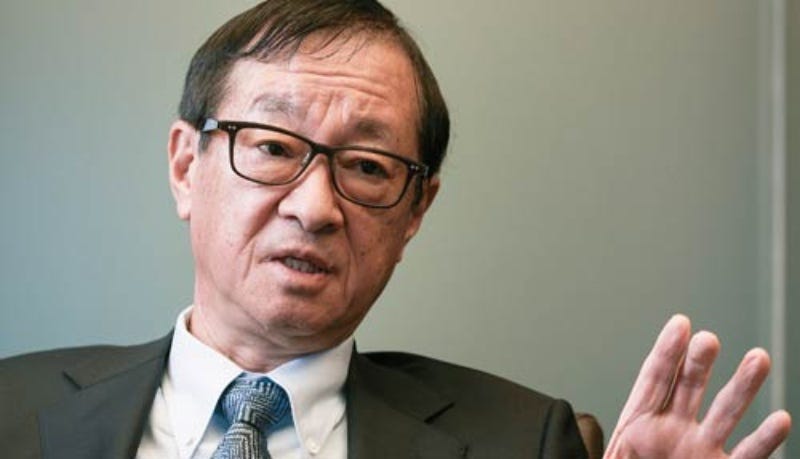
In my experience, Japanese turnarounds involving “Salaryman CEOs”, like in this case, can be subtle and hard to spot. This is because:
These CEOs often rise from within the ranks, rather than being experts brought from the outside. They can be company lifers, as is the case with Eiji Hashimoto. At first glance, they don’t seem all that different from their predecessors.
As a result, they also don’t have a “track record.”
Japanese CEOs are underpaid. The portion of their compensation which is tied to performance is very small relative to US and European CEOs. “What incentives do they have?” is the question investors might ask.
If American corporate turnarounds are like this:
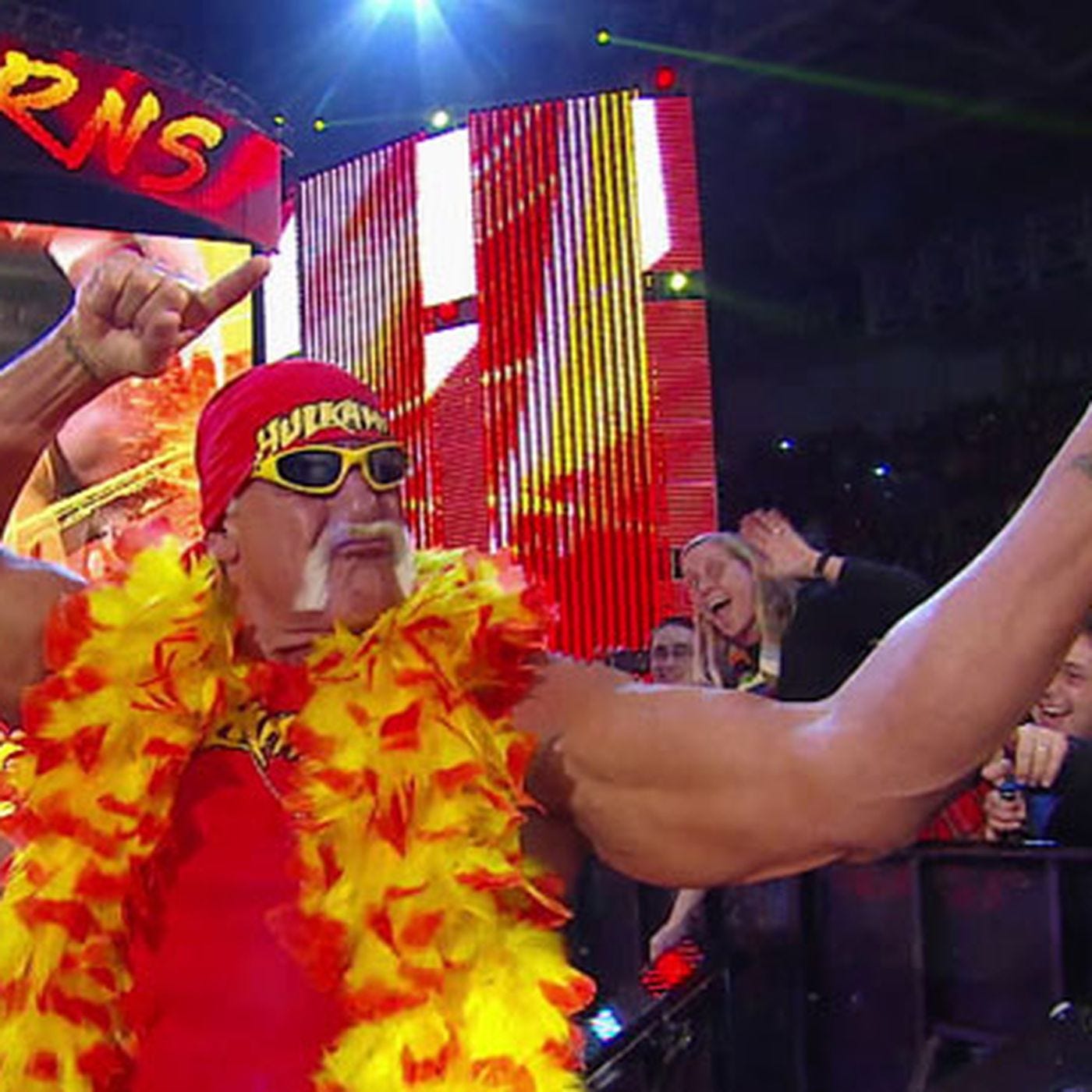
Then Japanese “salaryman CEO” turnarounds are like this:
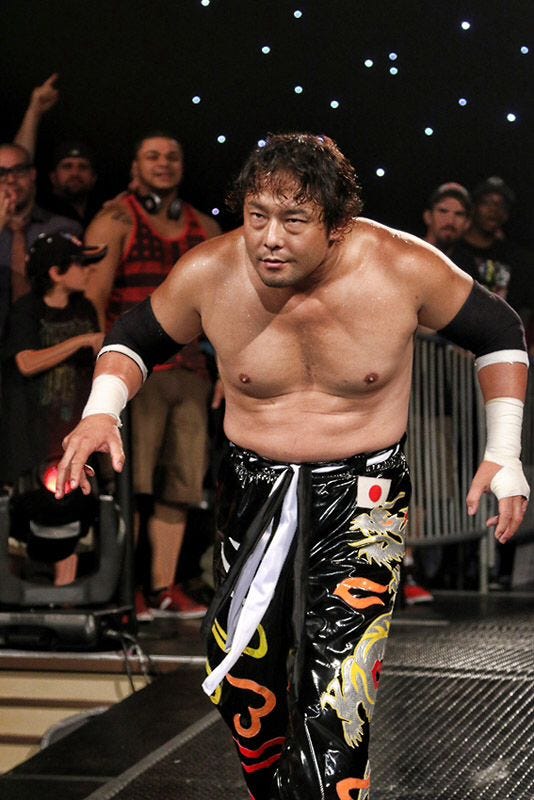
And when you underestimate the salaryman CEO, this is what happens.
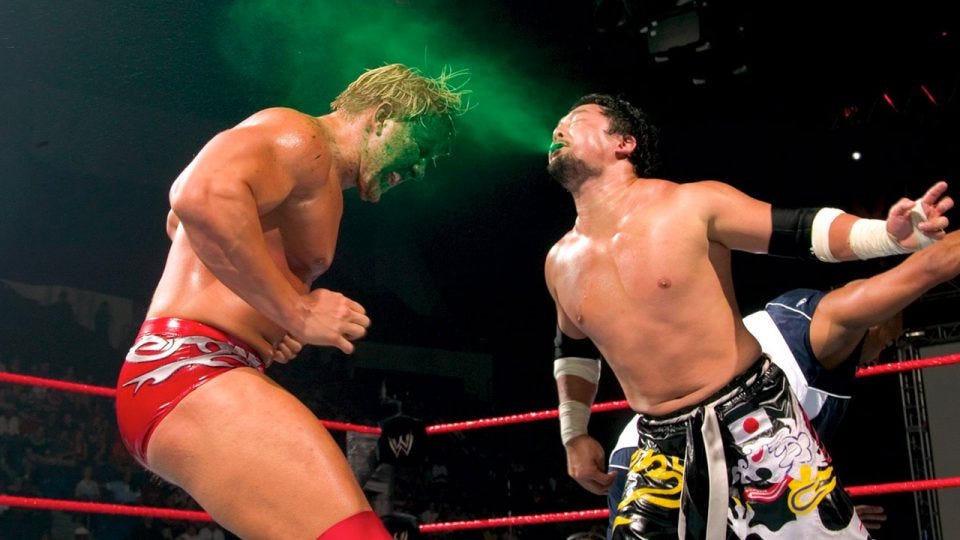
When a guy like this comes along, it can unlock a lot of value for shareholders. Salaryman CEO turnarounds are underappreciated.
Eiji Hashimoto stands out as an unconventional leader. He obtained his Master’s degree from the Harvard Kennedy School, and was known for his “insubordination” at the workplace. In earlier years, his unwillingness to conform to traditional Japanese business approaches while working as a salesperson in Japan led to a fractured relationship with his boss. This led to Hashimoto being “sidelined” to Nippon Steel’s overseas businesses, where he would become involved in the company’s operations in Asia, the US, and Brazil.
A characteristic of these reform-minded salaryman CEOs is that they have quietly risen through the ranks, driven by a dissatisfaction with the status quo. They have a strong sense of mission to drive change, which can be unrelated to personal financial gains.
What did it take to turn around Nippon Steel? I will discuss four key points.
Dealing away with antiquated Japanese business practices
Reclaiming bargaining power with large clients
Headcount reduction
M&A and growth investments
Antiquated Japanese business practices
Japanese companies conform to global business practices when doing business overseas. But when it comes to domestic dealings with other Japanese companies, they often adhere to traditional business practices (which may seem highly illogical to outsiders).
Here’s an example from the steelmaking industry. Nippon Steel would ship products to key clients, like automakers, and negotiate on prices only months after delivery.
For sales made from April to September, the pricing discussions would occur in August. They are shipping products from April to August, without knowing what customers would pay for them! Nippon Steel didn't set the prices for its goods; effectively, the customers did.
After Hashimoto became the CEO, he abolished this practice, making sure that prices were negotiated and finalized before any shipments were made. For sales occurring between April and September, prices are set by February, reflecting forecasts of raw material costs and other factors.
This is part of a broader issue in Japan, where companies lower in the supply chain deal with immense pressure and unreasonable demands by those at the top. Even the country’s largest steelmaker is doing business this way, so you can easily imagine how much worse the situation gets at some of the smaller suppliers.
As Japanese companies pursue reform in recent years, outdated practices and power dynamics like these are gradually being addressed.
Reclaiming bargaining power with large customers
Foreign investors may not appreciate just how hard it is to raise prices in Japan and what kind of a psychological barrier this represents. This is especially so when we are talking about raising prices against large customers, such as automakers. The last time Nippon Steel raised prices was in 1990!
Pricing negotiation with large customers can be detached from market reality. For example, even when global steel prices are rising, Japanese customers often asked Nippon Steel to lower prices. There is no economic basis for negotiation, and only power dynamics. The culture at Nippon Steel has been to just cave into customer demands, fearing volume loss.
What Hashimoto saw was that steelmakers had supplier power that wasn’t being exercised. After years of consolidation, the industry had come to a point where the power balance has shifted. In a move that shocked the industry, Hashimoto told automakers that he will raise prices, and that shipments will be halted to any automaker that doesn’t accept the price hike. He knew that the automakers could not refuse.
Nippon Steel is also the technology leader in areas like super high-tensile steel that contributes to making vehicles lighter. Despite investing significantly in R&D for these products, Nippon Steel had trouble convincing Japanese automakers to pay more. Hashimoto’s goal was to make sure the high value-add of these products were properly reflected in the pricing.
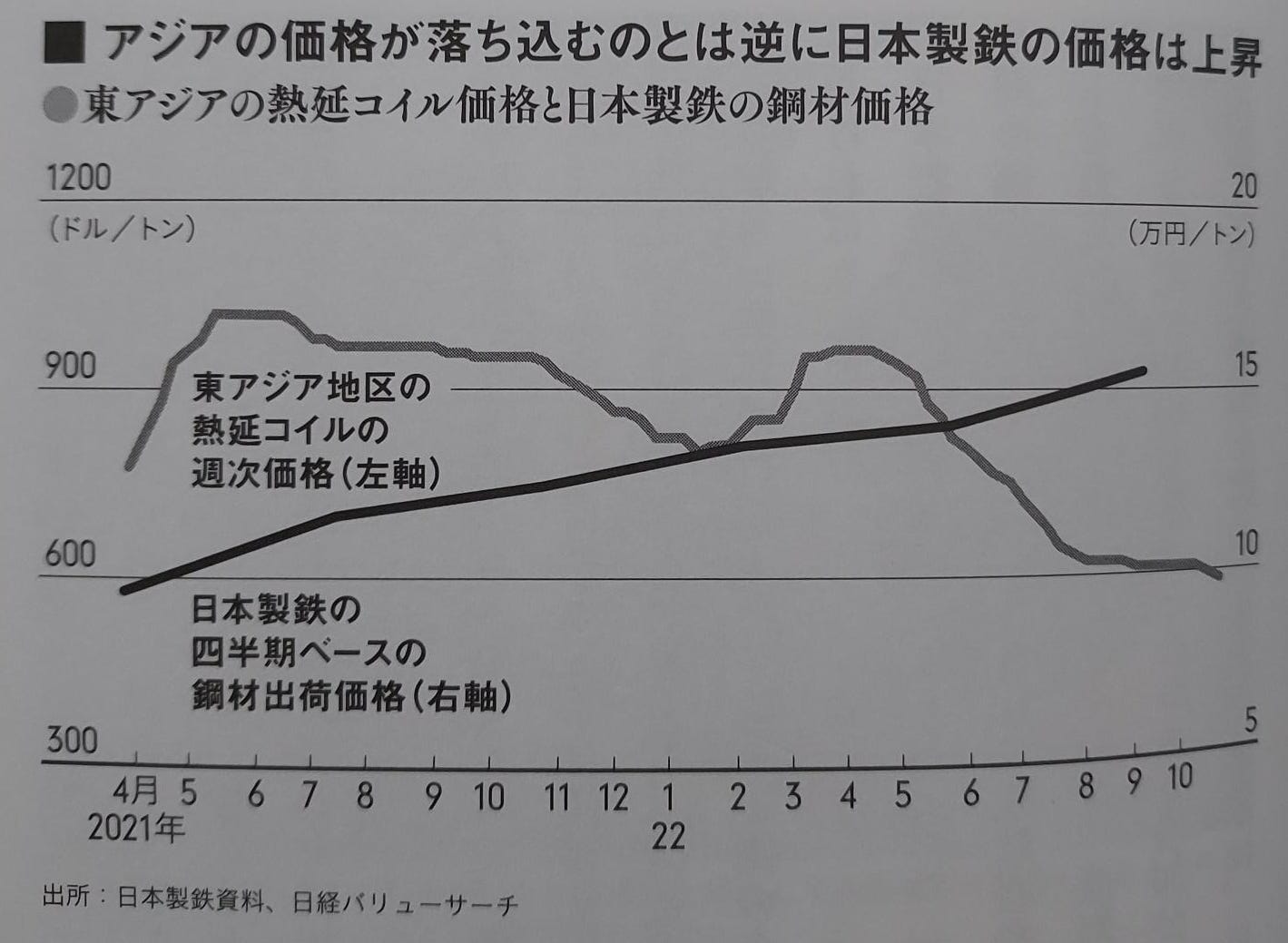
As shown above, Nippon Steel’s pricing has risen ~50% from April 2021 to October 2022, from 100k yen per ton to 150k (solid black line). Impressively, this came at a time when the market price of steel had declined (grey line). Hashimoto was right - there was a significant amount of untapped pricing power.
However, what Hashimoto brought in was not just a one-time price increase. He changed the culture of how the company views its own power dynamics with its large customers. Everything would be done fair and square, based on capitalism and market-based principles.
Here’s one example. In 2021 Nippon Steel did the unthinkable by suing Toyota, its largest customer. Nippon Steel claimed that Chinese Steelmaker Baoshan Steel had infringed its patent on a type of product called “non-oriented magnetic steel sheets” that are used in electric vehicles. Nippon Steel decided that it would not only sue Baoshan, but also Toyota as well, which was procuring this product from Baoshan.
This was a strong message sent to Toyota and Nippon Steel’s other customers. Effectively, they are equals from now on, and that special treatment will be given to no one.
Headcount reduction
Facing declining volume in the domestic market, Nippon Steel restructured its business by reducing the number of blast furnaces from 15 to 10 and cutting its workforce by 20%.
Layoffs are a particularly sensitive topic for management teams, but especially in Japan, where employment is considered sacred. Large-scale layoffs are culturally taboo, requiring strong determination to push through. Just how strong? Hashimoto’s determination can be seen in the following anecdote, which left a significant impression on me.
Nippon Steel’s blast furnace operation at Kure City, Hiroshima employed 3,300 people. When the company decided to close this operation, it did so without informing the local government. Needless to say, this was tradition-shattering. Local government officials only found out about the news at the company’s public press conference, which left them stunned. Despite subsequent appeals from the government to reverse the decision, Hashimoto didn’t budge.
When asked about this incident, Hashimoto explained that consulting with the local government and seeking their “understanding” would have compromised his resolve and his ability to achieve the necessary restructuring goals for the company.
He believed it was a choice between making tough individual decisions or risking the entire company's future, and for him, the path was clear.
M&A and growth investments
Corporate transformation cannot be just about cost cutting. There has to be a plan to grow. Nippon Steel is pursuing a growth strategy of acquiring foreign steelmakers.
In recent years, geopolitics has led to increased protectionism around the world. Steel is regarded as a strategic industry and governments around the world have enacted policies to favor local production, imposing tariffs to discourage imports.
Historically, Nippon Steel produced semi-finished products in Japan and shipped them overseas for local processing into final products. However, due to tariffs, its new strategy is to acquire local steelmakers and to conduct entire manufacturing overseas. Nippon Steel has been focused on India and the US (given their geopolitical alignment with Japan) and have made significant investments.
Nippon Steel has taken a unique approach to M&A, whereby it has partnered with ArcelorMittal in several cases to penetrate into the US and Indian markets. The companies established a joint venture, AM/NS Calvert, in the US in 2014. In 2019, they jointly acquired the bankrupt assets of Essar Steel, the India’s fourth-largest steel producer, and jointly operate the business.
It appears that the partnership has been successful so far, despite cultural differences. It is said that Hashimoto (who is Harvard-educated and fluent in English) has a strong personal relationship with the Mittal family, frequently meeting and discussing strategy even as they operate as both partners and competitors at the same time.
Historically, Japanese management has gotten a bad rep for their capital allocation (deservedly so). But perhaps it’s worth asking: can the new generation of Japanese management allocate capital better than their predecessors? Are they able to better operate across cultural barriers? I will be watching this with a lot of interest.
Conclusions
Since Hashimoto took over as CEO in April 2019, Nippon Steel has generated a total shareholder return of ~100%, outperforming the TOPIX index during this period.
Nippon Steel’s transformation serves as a case study of how even the “worst” can change. This provides corporate Japan with both hope and a potential blueprint for change.
In conclusion, more than ever, Japanese companies that are genuinely committed to change merit serious consideration from investors.